 Twilight Workshop
Three Figures in the Endless Meadows of Zarasai
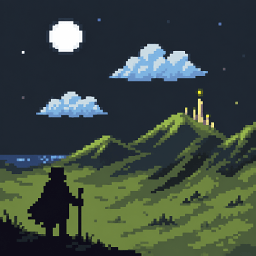
Somewhere between Zarasai and Visaginas in Lithuania, there are hills where the meadows seem endless. In one direction—grass, hills, shrubs, one tree here and another there. In the other direction—more of the same. You climb to the top of a hill, only to see... another hill. Beyond it stands another, and beyond that—another, exactly the same, as though nothing else could possibly exist around them. This tale is about such a place.
Once, some friends drove there from Vilnius to camp. They were celebrating Vytautas’s birthday. They had already spent a long time walking through the surrounding woods, and now they planned to roast sausages and talk beside the fire. The city folk were amazed by how much empty space there was. They were used to empty places soon filling up with a farmhouse, a road, a gas station, or at least a cultivated field. But in that special place, there was nothing except meadows, grass, and hills, softly rolling all the way to the horizon. Everyone was in a very cheerful mood—they pitched their tents, built a fire, and talked the sort of nonsense people talk when they are still very young, but no longer children. Vytautas laughed too. To tell the truth, he did not much like sleeping outdoors. He especially disliked sleeping on cold ground, finding spiders in his shoes, and other such things connected with camping. But this time, he thought, “What a beautiful night it will be.” Above their heads, the first (not quite a) star, Venus, had already risen. The (almost) full moon glared brightly, and the tall grasses in the fields had taken on an indescribable silvery color—the color of night that appears only on a warm summer evening.
Time passed quickly, and the burning embers carried the boys’ stories skyward on the August wind. They remembered the old days and their childhoods, and then discussed their plans for the future. Little by little, Vytautas fell asleep in the warmth of the fire. Half an hour passed. Suddenly, all the others quietly stood up, exchanged glances, and formed a circle around him. They waited for a while, until they were completely certain that he was asleep. Then, giggling under their breath, they gathered up all their things, threw them into the tents, and dragged the tents toward the cars, which were parked farther away, beyond the hill. They even took Vytautas’s backpack, and his best friend had slipped the phone out of Vytautas’s pocket. The electric cars drove away without a sound. Only the night fliers watched their lights disappearing across the hills—up and down, up and down—until at last they vanished. The night concealed the grass flattened beneath the wheels, and the friends’ final laughter echoed somewhere far away. And so Vytautas remained there, sleeping alone beside the dying fire.
He woke at about three in the morning. The moon was already hiding behind the hills. First he felt the cold. Then he noticed an unpleasant dampness against his back—a cold sweat, like the kind you get when lying directly on an air mattress. Slowly, he realized that he was beneath the open sky, in darkness. He sat up. Everything around him was empty and silent—there was no wind. There were also no tents, no friends, and no fire. Only a few embers still glowed. He felt around himself and discovered that his phone was gone too. For a while, he did nothing.
“Those rotten creeps,” he finally said to the darkness, realizing what a nasty birthday trick his friends had played on him.
His voice sounded strangely small, without even the faintest echo. He stood up, but going anywhere in the middle of the night did not seem sensible. Where could he go? In which direction? Everything around him looked the same. Although, to eyes that had grown used to the darkness, it was not really very dark. He decided to wait until morning. His friends would probably return to pick him up then.
He touched the tall grass with one hand. It was cold and wet. He could not cover himself with it, although the thought of pulling up great armfuls of grass had occurred to him. So he curled himself into a ball and lay on his side. Now he could see far across the meadows. They still shone with silver. The grass was tall and covered in drops of dew, and thousands of spiders spun their webs between the stems. Vytautas looked at all that beauty and tried not to be angry. Then it seemed to him that something was moving in the distance.
At first, he watched while still lying down. And yes, very far away, beyond one, two... seven hills, three pale little dots were slowly moving through the meadows. Vytautas sat up, looked more carefully, and laughed.
“Aha,” he muttered. “You’re coming back, you devils.”
It was obvious to him: his friends had decided to frighten him. They had pretended to drive away, and now they were returning, probably dressed up in some sort of costumes. Audrius had most likely planned the whole thing. “I’ll show you,” Vytautas thought. He looked around. There was only one larger bush nearby. It grew a little lower down, beside the edge of a hollow. Vytautas chose it as his hiding place. When his friends came closer, he would leap out and frighten them instead. He waited. The three pale dots disappeared behind a hill. After a while, they appeared on top of the next one—slightly larger now. Then they disappeared again. They rose over a nearer hill, then another, and so again, and again. They were walking directly toward him. Vytautas narrowed his eyes to see more clearly.
Only three hills and three hollows separated them now. In the moonlight, he could already make out what looked like heads, arms, and legs. But something about them was wrong. That was not how people walked. That was certainly not how his friends walked. Their arms were too long. As they moved, they rested them against the ground, the way Vytautas had once seen gorillas walk, or... well, some sort of apes on television. “They’ve really made an effort this time,” Vytautas thought, secretly pleased that they had gone to so much trouble for him. But if he had been completely honest with himself, he would not quite have believed the sound of his own voice. Something about them really was wrong.

Another five minutes or so passed. The figures disappeared behind a hill and appeared again, much closer. Only a couple of hundred yards separated them now. A chill shook Vytautas. It felt as though a gentle night wind had touched his back, although perhaps there was no wind at all.
Now he could see them better, and he did not like what he saw. They were naked—or at least they appeared to be naked—and it would have been difficult to make costumes like that. In the moonlight, their skin glowed gray—dry, stretched too tightly over the bones; he could see every rib. Their heads were almost bald, with only a few long strands of hair trailing in the wind. Their arms were long, so long that the figures could rest them against the ground as they walked, and they bent once more somewhere in the middle—as though each arm had two elbows. Their heads swayed from side to side, somehow unnaturally, too softly. If those were his friends, they must have been terribly uncomfortable.
Without realizing it, Vytautas took one step backward. Then another. After that... he did it quite deliberately. He ran down the hill, crossed the hollow, and climbed the next one. At the top, he turned around. The figures had not come any closer, but neither had they fallen behind. They simply continued moving in the same way—at the same speed, up a hill, down a hill, and the same again.
Cold sweat broke out across Vytautas’s skin, as cold as the night itself. The figures had already crossed the top of the hill where he had slept—the place he had just run from. “They didn’t stop. They didn’t even stop to look where I went...” All sorts of thoughts spun through his head. “Well, I’ll still show you,” he hissed through his teeth.
He was still trying to believe that they were his friends. Perhaps they had a night-vision camera or a thermal-imaging camera and could see him in the darkness. That was why they were following him. Tomorrow, they would all laugh until they cried. But Vytautas decided not to take the risk. “Those costumes are too good,” he said under his breath, although speaking was difficult because he was so out of breath from running. He climbed another hill. At the top, he turned around again. The distance between him and... them... had increased slightly, but not by much. The figures continued walking, still directly toward him.
He decided to try running sideways. At the bottom of the hill, inside the hollow where the hill would hide him from view, he would turn right. Then he would run as fast as he could. He would move away from their path, and then, hidden by the darkness, he would crouch behind those shrubs over there. Once the figures had passed, he would run in the opposite direction—the direction they had come from—and search for a gravel road or a farmhouse. He raced downhill, turned sideways, plunged into the bushes, and crawled up toward the top of the hill. The grass was wet, the earth stuck to his palms, and puddles gleamed beside the bushes. He crawled straight through them. He no longer cared about staying dry. Staying alive was more important. Soon he was covered in mud, pollen, and heaven knew what else. He stopped, lay down, and peered through the branches toward the meadows. It was almost cozy there.
The figures were nowhere to be seen. Vytautas waited for them to appear on his right, climbing the hill—at least, that was where they would appear if his trick had worked. The tension was terrible. After a few seconds, or perhaps a few minutes—time was moving so slowly—terror locked his calves and tickled his stomach. The figures were walking directly toward him. That meant they knew exactly where he was. They could see him, or somehow sense him. A shiver ran down his back again. Now they were very close. Only one hollow between two hills separated them, about the size of a small soccer field at a school. They were somewhere near the place where he had decided to turn aside. From this distance, Vytautas saw how quickly they truly moved. Their movements themselves were slow, but their limbs were long, and their steps were long. And the creatures never rested. Their arms reached the ground, their legs bent strangely, and their bodies floated forward through the tall grass, trotting again and again with an odd, steady rhythm.
They began descending into the hollow. All they had to do now was climb the hill where Vytautas was hiding. Vytautas ran. This time, he truly ran—the way a person runs for his life. Up a hill and down a hill, with every last bit of strength he had. The grass whipped his shins. His shoes slipped on the wet earth. His chest burned. When he reached the top, he turned around. The figures were not slowing down.
Up a hill and down a hill, as though the meadows beneath them were as flat as a tabletop. They did not breathe harder. They did not stumble. They did not stop. Their long arms reached the earth, their gray bodies floated through the silver grass, and their heads swayed from side to side.
“Meadow Monsters,” Vytautas thought.
And the thought itself frightened him.
“Meadow Monsters!” he shouted at the top of his lungs as he ran. Saying it aloud seemed to turn his nightmare into something real. Now it was real for certain.
He ran for a long time. Perhaps ten minutes. Perhaps more. Time in the meadows was strange. Every hill looked like the final one, but whenever he climbed to the top, another hill appeared before him. And then another. Silver grass, dark shrubs, one black tree, then another. Another hollow. Was it the same one? Up again.
“When will these cursed hills end?” he hissed. His strength was fading. The figures were still walking. They neither chased him faster nor fell very far behind, no matter how hard he tried. It was true that four hills separated them again now. But whenever he stopped, they began coming closer, and he had to stop more and more often. His lungs burned. He tasted metal in his mouth. A pain stabbed his side so sharply that it felt as though someone had seized him with pliers and was pulling.
Vytautas caught his foot on a root and fell to the ground. Pain shot through his leg. Cursing, he tried to stand, but his leg felt somehow crooked. He walked with a limp. Then he tried to run again. Up a hill and down a hill. Only now he was no longer really running. He limped, fell, stood, and limped again. Every descent stabbed his leg. Every climb burned through his entire body.
Up a hill and down a hill.
Then he saw a farmhouse. It was dark, with sagging walls, standing alone among the endless open spaces. Perhaps he would find help there, or at least solid walls and a door he could lock. He gave every bit of strength he had left to reaching it. The farmhouse stood on top of a higher hill. From nearby, it looked even worse. The roof sagged inward. The door was crooked.
Vytautas pounded on it with his fists.
“Hello! Is anyone there? Open up!”
No one answered, and the place did not look as though anyone could possibly live there. Vytautas turned around. The figures were still far away, but they had not disappeared. He kicked in a window and climbed inside. Perhaps they would not fit. It was darker indoors than outside. The house smelled of mold, wet wood, and something sour, heavy, and stale. Vytautas frantically felt along the walls, the table, and the windowsills. He searched for a telephone, wires, anything at all. But there was nothing there except dust and the shadows of old objects. The floor beneath his feet was soft. The boards bent when he stepped on them. Then one of them simply gave way and broke.
Vytautas fell.
He fell into a cellar beneath the floor—the sort people once dug beneath their kitchens to store pickled cucumbers, jam, and bottles of juice. He struck his side and hit his head against something that crunched almost like branches. He hit it so hard that white spots leaped across his vision. There were no jars in the cellar, no barrels, and no shelves. On one side, reaching almost to the ceiling, lay a pile of bones.
Human bones.
At first, Vytautas’s mind seemed to refuse to recognize them. White sticks. Gray fragments. Strange round objects with holes in them. Then the moonlight fell through the broken floor and landed on a skull. It stared at Vytautas through empty, lifeless eye sockets. There were so many bones that they formed a slope all the way to the ceiling. Arm bones. Leg bones. Ribs. Jaws. In some places they were clean and old. In others they were still dark, coated in something dried and shriveled. One hand stuck out of the pile as though its owner had tried to climb free and had fallen short by only a little. The cellar was filled with the smell of death. A dry, dusty, ancient smell, with something fresher underneath.
Then Vytautas saw an opening in the wall. A large opening. One entire wall had been dug away, and a tunnel led onward into the darkness. Vytautas understood where he had fallen. This was probably the monsters’ den—the place where they fed. With the last of his strength, he dragged himself toward a rotten ladder. One rung broke beneath his hand. The next one held. He climbed, groaning and clenching his teeth so hard that his jaw began to ache. Several ribs crumbled beneath him. Something small rolled down the slope of bones and stopped only when it struck the wall.
Vytautas pulled himself back into the kitchen and limped toward the window. The figures had nearly reached the yard. They were still moving exactly as before. They were tall—perhaps twice the height of a person. “Why did you leave me here?” Vytautas thought, almost whimpering inside his own mind. He kicked out a window on the opposite side of the house and jumped through it. He screamed when he landed. His leg would not let him run. Now blood was flowing from it too. He had cut himself while climbing through the broken glass. Still, he tried to run. What else could he do? He stumbled down the hill, fell, stood, and fell again. Grass stuck to his face. There was earth in his mouth.
A pleasant little breeze rose in the meadows, gently swaying the grass. Except for Vytautas’s gasping and cries, everything was quiet and peaceful. Only grass, shrubs, and a small tree here and there. Somewhere very far away, there was a road. There was a town. People slept in their homes, tucked warmly beneath their blankets, dreaming beautiful dreams.
They caught him on the next hill. Inevitable as the night itself while the earth turns. He had still managed to roll down the previous hill, but he could barely climb the next one. Vytautas fell to the ground.
“That’s it,” he thought. “I can’t go any farther.”
The figures approached, crept close without a sound, and surrounded him. For the first time, they stopped. They did not hurry. They seemed to be studying him. Now he could see them clearly.
Their bodies were gray, long, and dry—the skin stretched straight over the bones, and he could see every joint, every vertebra. And there were too many joints: their arms and legs bent not in one place, like a person's, but in two, folding at weird angles, like an insect's. Their long fingers ended in curved claws. Their heads were almost human heads—and that was the most terrible thing. Pointed ears, a few long strands of hair on a bald skull, small nostril holes. And eyes—round, black, without whites, reflecting neither the moon, nor the stars, nor Vytautas himself. They swayed above him and watched without blinking.
Simultaneously, all three mouths opened. There was a clicking sound. Wide, lipless, filled with rows of small, sharp teeth—and they kept opening, wider and wider, too wide, the jaws dropping down the way a human jaw does not drop. One monster crouched on all fours, lowered its head along the ground, and closed its teeth around his forearm—not the whole arm, only as much as fit between its jaws.
Vytautas screamed terribly. First he felt the teeth—small, sharp, sinking all the way to the bone. And then the sucking began. The monster drew blood through the wound so violently that the vessels beneath his skin were bursting around the bite, and his arm grew numb and empty, like water being wrung from a rag. It felt as though his forearm had been pushed between millstones. And then he felt nothing. He could only see a second monster sinking its teeth into his leg, but he no longer felt it. The third bent over his face, and its mouth kept opening, wider and wider—wider than his whole face.
The last thing Vytautas saw was the first sign of the approaching dawn—a reddish light somewhere in the east, beyond that gaping, tooth-filled mouth.
The next morning, his friends returned. At first, they laughed and called Vytautas’s name. They filmed with their phones because they wanted to record him crawling angrily out of some bush.
But Vytautas did not come out. They searched for him for a long time. They found trampled grass, but it looked as though it had been trampled by something large—something that was not human. They tried to follow the trail, but they could not believe that Vytautas had made it. So they stopped following it and decided that he had probably become angry and walked home. No one ever found him. His friends never played such a trick again, and they never spoke about that night.
Only Vytautas’s bones were probably slowly turning to dust in the cellar of the old farmhouse. Such things happen somewhere in the meadows of Zarasai. Or perhaps they do not. You will never know.
Translated from the Lithuanian original at https://sutemudirbtuves.lt